

If you play a left-handed guitar, you may have discovered that replacing the electronics isn't always as simple as buying a standard wiring harness and installing it backwards.
Left handed guitars can require different potentiometers, control layouts and wiring considerations to make the volume and tone controls operate naturally for a left-handed player.
The good news is that the basic principles of guitar wiring remain the same. Pickups, switches, capacitors and output jacks still perform the same jobs. The important difference is how the controls are designed to operate when the guitar is played in a left-handed orientation.
ObsidianWire's dedicated Lefty! guitar wiring range was developed specifically around these requirements, using left-hand/reverse-taper potentiometers and guitar-specific mounting dimensions rather than simply adapting a right-handed harness.
Quick Answer: Do Left Handed Guitars Need Different Wiring?
Sometimes — and the biggest difference is usually the potentiometers rather than the pickup circuit itself.
A conventional right-handed harness can often be physically installed into a left-handed guitar, particularly on guitars with symmetrical control layouts. However, the controls may operate backwards.
For example, a standard right-handed volume control is normally designed so that:
- Clockwise = increase volume
- Counter-clockwise = decrease volume
On a left-handed guitar, the physical orientation of the control is mirrored. Without appropriate left-handed potentiometers or an appropriate wiring arrangement, the control can therefore operate in the opposite direction to what the player expects.
Dedicated Lefty! harnesses address this with specially specified left-handed/reverse-taper potentiometers designed to provide the appropriate control direction and taper.
Left Handed vs Right Handed Guitar Wiring
| Feature | Right-Handed Guitar | Left-Handed Guitar |
|---|---|---|
| Pickup circuit | Standard | Essentially the same |
| Potentiometer orientation | Right-hand | Left-hand/reverse |
| Volume direction | Designed for right-handed orientation | Designed for left-handed orientation |
| Tone direction | Designed for right-handed orientation | Designed for left-handed orientation |
| Pot taper | Standard/right-hand | Left-hand/reverse taper may be required |
| Control plate/pickguard | Right-hand specific where applicable | Left-hand specific where applicable |
| Harness fitment | Model dependent | Model and orientation dependent |
| Switch circuit | Model dependent | Usually electrically similar, but physical orientation matters |
The key point is that lefty guitar wiring isn't necessarily a completely different electrical circuit.
Instead, the physical orientation of the guitar changes how the controls are used, which makes the choice of potentiometers and physical mounting particularly important.
What Is a Left Handed Potentiometer?
A potentiometer, or pot, is the component used for guitar volume and tone controls.
A potentiometer has a resistive track and a wiper. Turning the shaft changes the electrical relationship between the terminals, allowing it to function as a volume or tone control.
Potentiometers can be manufactured with different tapers and orientations.
For guitar applications, the taper determines how the control changes as you rotate it. A properly selected audio/logarithmic taper can make a volume control feel much more natural because perceived loudness doesn't change linearly with electrical resistance.
For a left-handed guitar, the physical direction of rotation is reversed relative to a conventional right-handed instrument.
That's where left-hand or reverse-taper potentiometers become important.
Why Does Potentiometer Direction Matter?
Imagine reaching for your guitar's volume control during a performance.
On a conventional right-handed guitar, you will normally develop the muscle memory that:
Turn clockwise → volume increases
A left-handed player looking at the mirrored control orientation can naturally expect the same intuitive relationship.
If a conventional right-handed pot is simply installed without addressing the orientation, the result can be:
Turn clockwise → volume decreases
Technically, the control still works. Practically, it feels backwards.
This is one reason a left-handed guitar wiring harness should not be judged purely by whether the guitar produces sound.
The control behaviour matters too.
Can You Use Standard Guitar Wiring on a Left Handed Guitar?
Yes, in some guitars and circumstances.
But there is an important distinction between:
"Will it work?"
and
"Will it work correctly for a left-handed player?"
Some standard harnesses can physically fit left-handed instruments because their mounting layouts are symmetrical. However, the controls may operate backwards.
That means simply finding a harness that physically fits the cavity isn't necessarily enough.
A left-handed player should also consider:
- Potentiometer orientation
- Volume direction
- Tone direction
- Pot taper
- Control-plate orientation
- Pickguard compatibility
- Knob compatibility
- Switch orientation
- Pickup configuration
Left Handed Stratocaster Wiring
Stratocasters are a particularly interesting case because the pickguard, control arrangement and pickup configuration all need to be considered.
A conventional Stratocaster typically has:
- Three pickups
- Five-way pickup selector
- Volume control
- Two tone controls
However, there are numerous Strat wiring modifications available, including:
- Blender wiring
- 7-way switching
- Master tone
- Master volume
- Treble bleed
- HSS wiring
- HSH wiring
- Series/parallel switching
- Coil splitting
For a left-handed Strat, the circuit can retain these same functions while using components designed around the left-handed control orientation.
Lefty Strat Blender Wiring
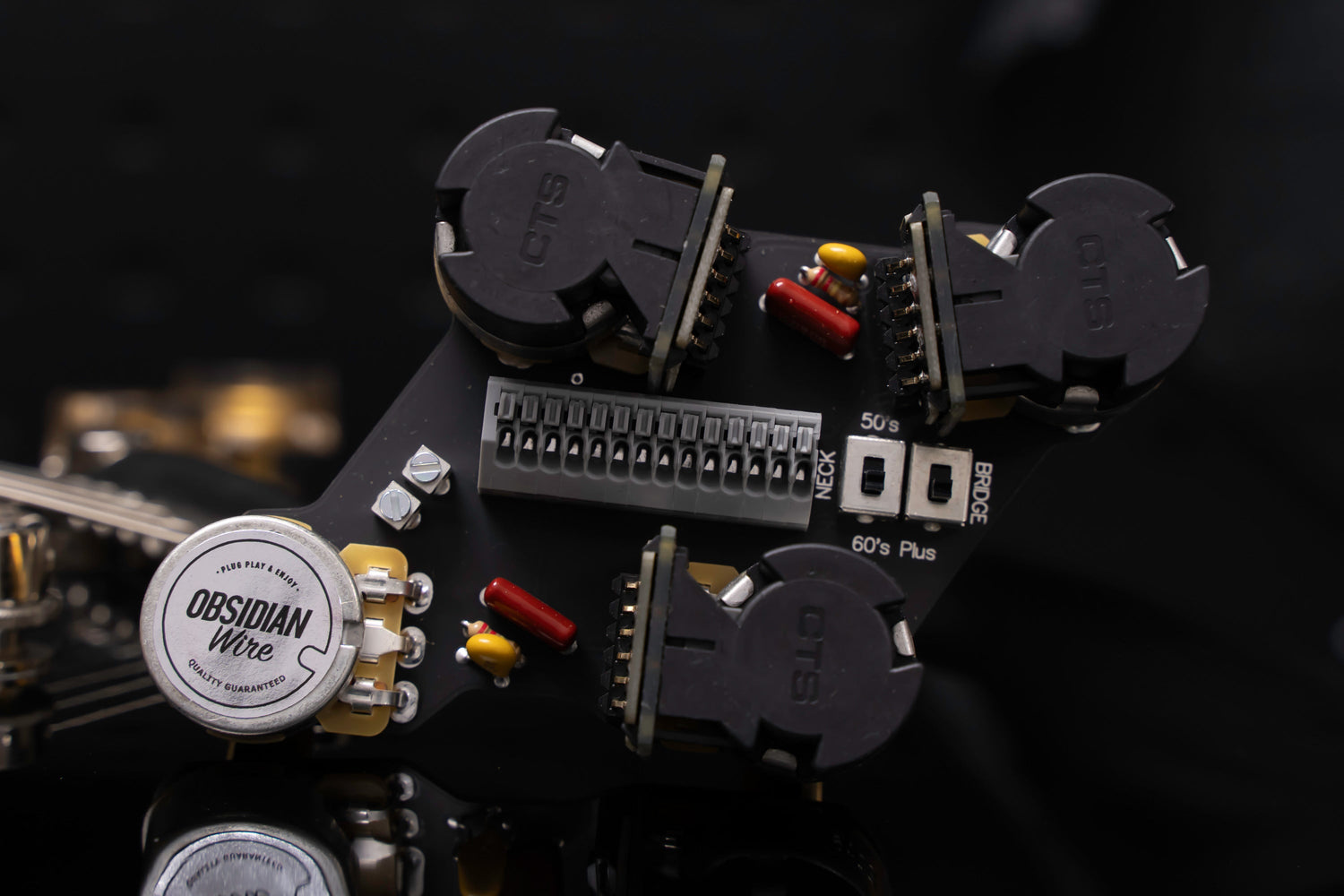
ObsidianWire's Lefty! Strat Universal Blender is an example of a dedicated left-handed Strat harness.
It supports SSS, HSS, HSH and HHH configurations and combines five-way switching with a blender control that can introduce additional pickup combinations.
With the blender turned off, it operates using conventional Strat pickup selections:
- Bridge
- Bridge + Middle
- Middle
- Neck + Middle
- Neck
With the blender engaged, additional combinations can be introduced, including neck + bridge combinations.
Explore Lefty Guitar & Bass Wiring
Left Handed Telecaster Wiring
Telecasters present a slightly different situation.
The traditional Telecaster circuit uses:
- Two pickups
- Volume control
- Tone control
- Three-way pickup selector
Because many Telecaster control plates have relatively symmetrical mounting geometry, a standard Tele harness may physically fit some left-handed instruments.
But again, physical fit doesn't necessarily mean correct control operation.
A dedicated Lefty Tele harness uses reverse-taper Lefty! pots and is designed specifically for left-handed Telecasters. It can retain traditional three-way switching while supporting different pickup configurations, including SS, HS, SH and HH.
Do Left Handed Guitars Use 250K or 500K Pots?
The basic principles of potentiometer resistance don't change simply because a guitar is left-handed.
The familiar values remain relevant.
250K Pots
250K pots are commonly associated with:
- Stratocaster single coils
- Telecaster single coils
- Traditional Fender-style circuits
A 250K volume pot generally loads the pickup more heavily than a 500K pot, resulting in a comparatively warmer/darker electrical response.
500K Pots
500K pots are commonly associated with:
- Humbuckers
- P90s
- Brighter pickup configurations
A 500K pot generally places less load on the pickup, allowing more high-frequency content through.
The important point is that left-handedness doesn't determine whether you need 250K or 500K pots.
Your pickup configuration does.
Do Left Handed Guitars Need Reverse-Taper Tone Pots?
This is where left-handed guitar wiring becomes more interesting.
The tone control needs to provide a useful and predictable change as the knob is rotated.
A poorly matched or incorrectly oriented pot can result in a control that technically works but feels unnatural.
A dedicated left-handed pot can be designed so that the usable control range follows the physical direction expected by a left-handed player.
ObsidianWire's Lefty! potentiometers are designed around the requirements of left-handed players, including appropriate control direction and taper.
Left Handed Guitar Wiring and Control Taper
Taper is one of the most overlooked parts of guitar electronics.
Two 500K potentiometers can have the same nominal resistance but feel very different when used as volume controls.
For example, one control might seem to do very little between 10 and 7 before rapidly dropping volume near the bottom of the range.
Another can provide a more progressive and usable change across the entire rotation.
For players who use the guitar volume control to clean up an overdriven amplifier, this can be particularly important.
A well-designed left-handed wiring harness therefore isn't simply about changing which direction the knob turns.
It's also about making the entire control response feel natural.
Do Left Handed Guitar Knobs Need to Be Different?
Not necessarily.
The knob itself is usually not electrically left- or right-handed.
However, compatibility is important.
Different guitars use different shaft types and dimensions, including:
- 24-spline split shaft
- Solid shaft
- Different shaft diameters
- Metric and imperial dimensions
This is why potentiometer compatibility and knob compatibility should be checked together.
What About Left Handed Loaded Pickguards?
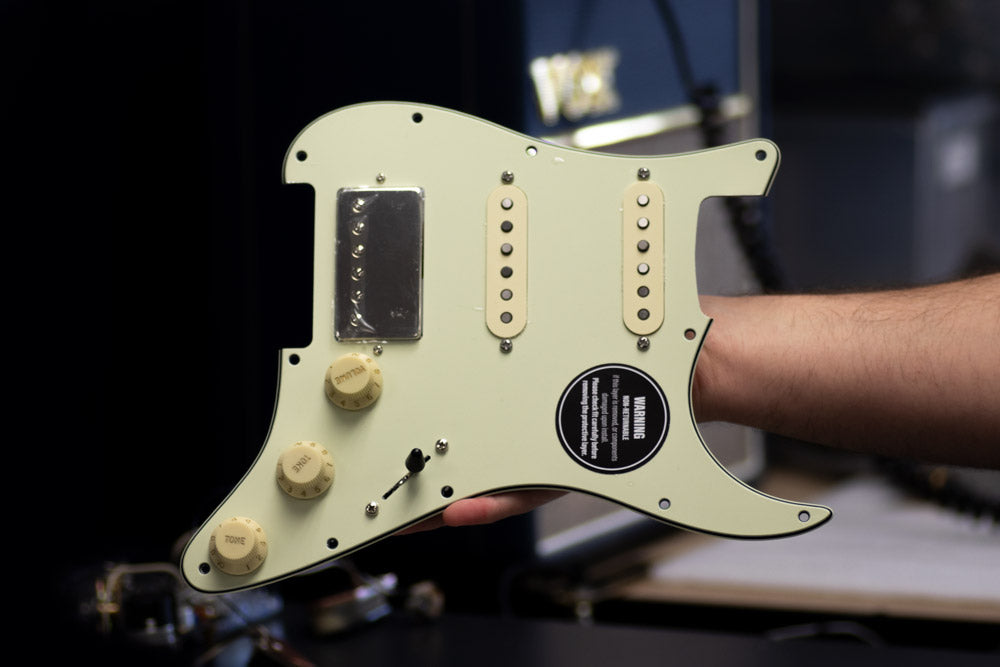
A loaded pickguard can be an attractive option for a left-handed Strat because it combines:
- Pickguard
- Pots
- Switch
- Wiring
- Capacitors
- Jack wiring
- Potentially pickups
into a single assembly.
The advantage is that the electronics can be designed and wired before installation rather than requiring the player to reproduce a circuit inside the guitar.
ObsidianWire offers dedicated Lefty! Loaded Pickguard options for Stratocaster.
View Lefty Wiring & Loaded Pickguards
Solderless Left Handed Guitar Wiring
One of the biggest practical advantages of a pre-wired harness is installation.
Traditional guitar wiring normally requires soldering:
- Pickup wires
- Potentiometers
- Capacitors
- Switches
- Output jack
- Ground connections
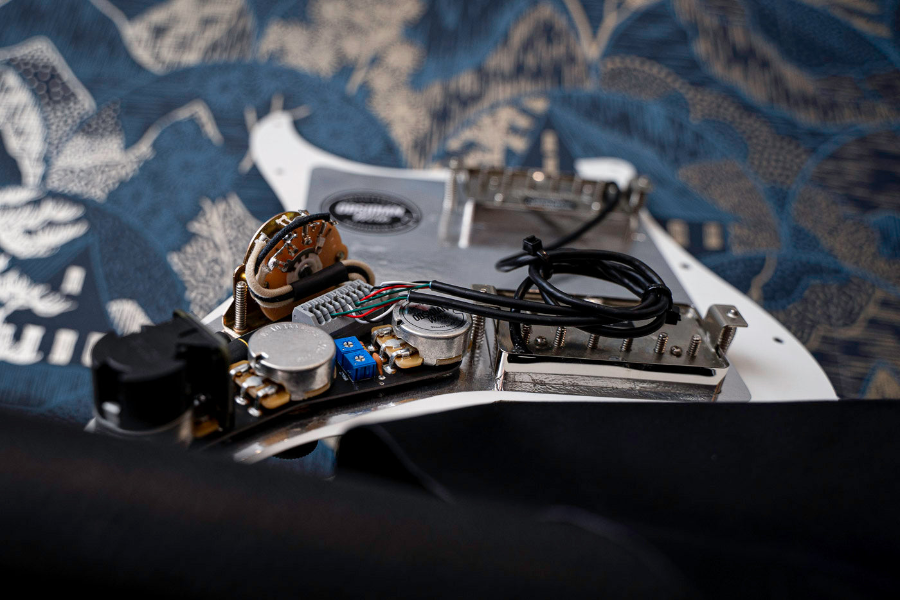
A solderless harness moves much of this work into the pre-built harness.
ObsidianWire's Lefty! range uses its Plug, Play & Enjoy connector system for compatible pickups, allowing pickup changes without traditional soldering.
That also makes future pickup changes considerably easier.
Instead of removing the entire control assembly and resoldering the circuit, compatible pickups can simply be disconnected and replaced.
Are Left Handed Guitar Wiring Harnesses Worth It?
That depends on what you're trying to achieve.
If your existing controls already operate naturally and you're happy with their taper, there may be no compelling reason to replace them simply because the guitar is left-handed.
A dedicated Lefty harness becomes more interesting when you want:
- Correct left-handed control direction
- Improved volume control taper
- Improved tone control taper
- Higher-quality components
- Additional pickup combinations
- Solderless pickup changes
- A pre-wired installation
- A specific Strat or Tele modification
The important distinction is that lefty wiring isn't automatically about making the guitar sound different.
Much of the benefit is about making the electronics work correctly and intuitively for the person playing the guitar.
Common Left Handed Guitar Wiring Mistakes
1. Assuming Any Strat or Tele Harness Will Work
Some may physically fit.
That doesn't mean the controls will operate correctly.
Always check whether the harness is specifically designed for a left-handed guitar.
2. Reversing Every Wire
Left-handedness doesn't mean pickup polarity, phase or coil wiring should automatically be reversed.
Only change the electrical circuit when the modification actually requires it.
3. Ignoring Potentiometer Taper
A pot isn't defined only by its resistance value.
A 250K or 500K label doesn't tell you whether the control will feel right for your application.
4. Forgetting Knob Compatibility
Changing to higher-spec pots may require different knobs.
Check:
shaft type + shaft diameter + spline count + knob compatibility.
5. Assuming the Control Plate Is Interchangeable
Particularly with Telecasters, control plates can differ in mounting dimensions, hole spacing and switch clearance.
Always check the specific guitar, control plate and harness compatibility before ordering.
Left Handed Guitar Wiring: The Key Takeaway
The easiest way to think about left-handed guitar wiring is:
The pickups don't necessarily need to be wired differently — the controls need to be designed to work naturally in the left-handed orientation.
A good Lefty harness therefore considers much more than simply reversing a wiring diagram.
It should take into account:
- Potentiometer orientation
- Reverse/left-hand taper
- Control response
- Physical mounting
- Pickguard or control-plate dimensions
- Knob compatibility
- Pickup configuration
- Switching requirements
- Installation method
That's the approach taken by ObsidianWire's dedicated Lefty! range, which includes wiring solutions for Stratocaster, Telecaster, Precision Bass and Jazz Bass, as well as loaded Strat pickguards.
For left-handed players, the goal isn't simply to make a right-handed circuit fit.
It's to make the controls behave like they were designed for a left-handed guitar in the first place.
Left Handed Guitar Wiring FAQ
Do left handed guitars need special wiring?
Not necessarily. The basic pickup circuit can be the same, but dedicated left-handed wiring can use reverse/left-hand potentiometers so that volume and tone controls operate in the expected direction and provide an appropriate control taper.
Can I install a right-handed wiring harness in a left-handed guitar?
Sometimes. Some guitars have symmetrical mounting layouts, meaning a standard harness can physically fit. However, the controls may operate backwards.
What is a reverse-taper potentiometer?
A reverse-taper potentiometer is designed so that its resistance change follows the opposite direction of rotation compared with a conventional pot. In a left-handed guitar, this can be used to provide intuitive volume and tone control behaviour.
Do left handed guitars need reverse-wound pickups?
No. Left-handed guitar orientation does not automatically require reverse-wound pickups.
Do I need to reverse the pickup wires?
No. Pickup wires should be connected according to the particular pickup and circuit. Arbitrarily reversing humbucker wires can alter coil-splitting behaviour and other functions.
Do left handed guitars use 250K or 500K pots?
Either. The appropriate value depends primarily on the pickups and circuit rather than whether the guitar is left-handed.
Can I use a lefty wiring harness with a right-handed guitar?
Generally no. Dedicated Lefty harnesses are designed around the physical orientation and control behaviour of left-handed instruments.
Can left handed guitar wiring be solderless?
Yes. Solderless wiring harnesses are available for left-handed guitars. ObsidianWire's Lefty! range uses its Plug, Play & Enjoy connector system for compatible pickup installations.
Explore Lefty Guitar Wiring
Looking for a left-handed wiring harness for your Stratocaster, Telecaster or bass?